Liberals Can Win Again if They Stop Being So Annoying
The Liberals Who Can't Quit Lockdown
Progressive communities take been home to some of the fiercest battles over COVID-19 policies, and some liberal policy makers take left scientific testify behind.
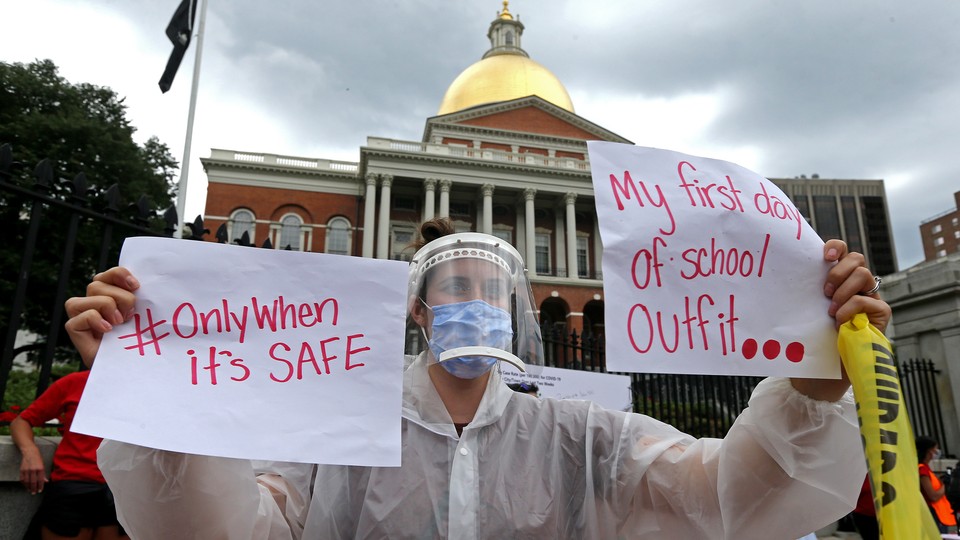
Lurking among the celebrating Americans venturing back out to confined and planning their summer-wedding travel is a different group: liberals who aren't quite ready to let go of pandemic restrictions. For this subset, diligence against COVID-xix remains an expression of political identity—fifty-fifty when that means overestimating the disease's risks or setting limits far more strict than what public-health guidelines let. In surveys, Democrats limited more than worry about the pandemic than Republicans practice. People who describe themselves equally "very liberal" are distinctly anxious. This spring, after the vaccine rollout had started, a third of very liberal people were "very concerned" about becoming seriously ill from COVID-xix, compared with a quarter of both liberals and moderates, co-ordinate to a written report conducted by the University of N Carolina political scientist Marc Hetherington. And 43 percent of very liberal respondents believed that getting the coronavirus would accept a "very bad" effect on their life, compared with a third of liberals and moderates.
Last year, when the pandemic was raging and scientists and public-health officials were still trying to understand how the virus spread, farthermost care was warranted. People all over the country made enormous sacrifices—rescheduling weddings, missing funerals, canceling graduations, avoiding the family unit members they dearest—to protect others. Some conservatives refused to wear masks or stay home, because of skepticism about the severity of the disease or a refusal to give up their freedoms. Only this is a unlike story, near progressives who stressed the scientific evidence, and so veered away from it.
For many progressives, extreme vigilance was in part near opposing Donald Trump. Some of this reaction was born of deeply felt frustration with how he handled the pandemic. It could also exist knee-wiggle. "If he said, 'Proceed schools open,' then, well, we're going to do everything in our ability to keep schools closed," Monica Gandhi, a professor of medicine at UC San Francisco, told me. Gandhi describes herself as "left of left," only has alienated some of her ideological peers because she has advocated for policies such as reopening schools and establishing a clear timeline for the end of mask mandates. "We went the other fashion, in an extreme way, against Trump's politicization," Gandhi said. Geography and personality may have also contributed to progressives' caution: Some of the virtually liberal parts of the country are places where the pandemic hit specially hard, and Hetherington found that the very liberal participants in his survey tended to be the nearly neurotic.
The bound of 2021 is different from the spring of 2020, though. Scientists know a lot more well-nigh how COVID-xix spreads—and how it doesn't. Public-health advice is shifting. Merely some progressives have not updated their behavior based on the new information. And in their eagerness to protect themselves and others, they may be underestimating other costs. Existence actress careful about COVID-nineteen is (mostly) harmless when it's express to wiping down your groceries with Lysol wipes and wearing a mask in places where yous're unlikely to spread the coronavirus, such as on a hiking trail. Simply vigilance can have unintended consequences when it imposes on other people'due south lives. Even equally scientific cognition of COVID-nineteen has increased, some progressives have continued to comprehend policies and behaviors that aren't supported by evidence, such every bit banning access to playgrounds, closing beaches, and refusing to reopen schools for in-person learning.
"Those who are vaccinated on the left seem to recollect overcaution now is the way to get, which is making people on the right question the effectiveness of the vaccines," Gandhi told me. Public figures and policy makers who try to dictate others' behavior without any scientific justification for doing so erode trust in public health and make people less willing to accept useful precautions. The marginal gains of staying shut downwards might not justify the potential backlash.
Due eastven equally the very effective COVID-19 vaccines have become widely accessible, many progressives continue to listen to voices preaching caution over relaxation. Anthony Fauci recently said he wouldn't travel or eat at restaurants fifty-fifty though he's fully vaccinated, despite CDC guidance that these activities can exist safe for vaccinated people who have precautions. California Governor Gavin Newsom refused in April to guarantee that the state'due south schools would fully reopen in the fall, even though studies have demonstrated for months that modified in-person pedagogy is safe. Leaders in Brookline, Massachusetts, decided this calendar week to keep a local outdoor mask mandate in place, fifty-fifty though the CDC recently relaxed its guidance for outdoor mask utilize. And scolding is all the same a popular pastime. "At least in San Francisco, a lot of people are glaring at each other if they don't wear masks exterior," Gandhi said, even though the risk of outdoor manual is very low.
Scientists, academics, and writers who have argued that some very depression-risk activities are worth doing as vaccination rates ascent—fifty-fifty if the adventure of exposure is not zero—have faced intense backlash. Later Emily Oster, an economist at Brown University, argued in The Atlantic in March that families should programme to take their kids on trips and see friends and relatives this summer, a reader sent an electronic mail to her supervisors at the university suggesting that Oster exist promoted to a leadership role in the field of "genocide encouragement." "Far too many people are non dying in our electric current global pandemic, and far too many children are not still infected," the reader wrote. "With the upcoming consequences of global warming nearly to be felt by a wholly unprepared worldwide community, I believe the fourth dimension is correct to get young scholars ready to follow in Dr. Oster's footsteps and ensure the most comfortable place to be is white [and] upper-center-grade." ("That e-mail was something," Oster told me.)
Sure, some hateful people spend their fourth dimension chiding others online. Merely for many, remaining guarded fifty-fifty every bit the country opens back up is an hostage expression of civic values. "I keep coming back to the same thing with the pandemic," Alex Goldstein, a progressive PR consultant who was a senior adviser to Representative Ayanna Pressley's 2018 campaign, told me. "Either yous believe that you have a responsibility to take action to protect a person you don't know or y'all believe you have no responsibility to anybody who isn't in your firsthand family unit."
Goldstein and his wife decided early on in the pandemic that they were going to take restrictions extremely seriously and adopt the most cautious interpretation of when it was safe to do anything. He'south been shaving his own head since the summertime (with "bad consequences," he said). Although rugby teams have been back on the fields in Boston, where he lives, his squad still won't participate, for fright of spreading germs when players pile on height of 1 another in a scrum. He spends his mornings and evenings sifting through stories of people who have recently died from the coronavirus for Faces of COVID, a Twitter feed he started to memorialize deaths during the pandemic. "My fear is that we will not learn the lessons of the pandemic, because we volition try to accident through the end line as fast as we can and leave it in the rearview mirror," he said.
Progressive politics focuses on fighting confronting everyday disasters, such equally climate change and poverty, struggles that may shape how some people see the pandemic. "If yous're securely concerned that the existent disaster that's happening here is that the social contract has been broken and the vulnerable in society are once again existence kicked while they're down, then yous're going to be hypersensitive to every detail, to every headline, to every infection rate," Scott Knowles, a professor at the S Korean university KAIST who studies the history of disasters, told me. Some progressives believe that the pandemic has created an opening for ambitious policy proposals. "Among progressive political leaders around here, in that location'due south a lot of talk effectually: We're not going dorsum to normal, because normal wasn't good plenty," Goldstein said.
In practice, though, progressives don't always concur on what prudent policy looks like. Consider the experience of Somerville, Massachusetts, the kind of community where residents proudly display rainbow yard signs declaring In this house … we believe scientific discipline is real. In the 2016 Democratic master, 57 percent of voters there supported Bernie Sanders, and this year the Democratic Socialists of America have a shot at taking over the metropolis council. As towns around Somerville began going back to in-person school in the autumn, Mayor Joseph Curtatone and other Somerville leaders delayed a return to in-person learning. A group of moms—including scientists, pediatricians, and doctors treating COVID-nineteen patients—began to experience frustrated that Somerville schools weren't welcoming back students. They considered themselves progressive and believed that they understood teachers' worries nigh getting ill. Merely they saw the city's proposed safety measures as nonsensical and unscientific—a sort of hygiene theater that prioritized the appearance of protection over getting kids back to their classrooms.
With Somerville kids still at dwelling, contractors conducted in-depth assessments of the city's school buildings, leading to proposals that included extensive HVAC-arrangement overhauls and the installation of UV-sterilization units and even automated toilet flushers—renovations with a proposed budget of $7.five million. The mayor told me that supply-concatenation delays and protracted negotiations with the local teachers' union slowed the reopening process. "No one wanted to get kids dorsum to school more than than me … It's people needing to feel safe," he said. "We want to make certain that we're eliminating any risk of transmission from person to person in schools and carrying that chance over to the customs."
Months slipped by, and testify mounted that schools could reopen safely. In Somerville, a local leader appeared to describe parents who wanted a faster return to in-person instruction equally "fucking white parents" in a virtual public meeting; a community member accused the group of mothers advocating for schools to reopen of being motivated by white supremacy. "I spent four years fighting Trump considering he was so anti-scientific discipline," Daniele Lantagne, a Somerville mom and engineering professor who works to promote equitable access to clean h2o and sanitation during disease outbreaks, told me. "I spent the last year fighting people who I commonly would agree with … badly trying to inject science into school reopening, and completely failed."
In March, Erika Uyterhoeven, the democratic-socialist state representative for Somerville, compared the plight of teachers to that of Amazon workers and meatpackers, and described the return to in-person classes as office of a "push button in a neoliberal social club to ensure, over and in a higher place the well-being of educators, that our kids are getting a competitive education compared to other suburban schools." (She later asked the socialist blog that ran her comments to remove that quote, because so many parents found her statements offensive.) In Somerville, "anybody wants to be actively anti-racist. Everyone believes Blackness lives matter. Everyone wants the Light-green New Deal," Elizabeth Pinsky, a kid psychiatrist at Massachusetts General Hospital, told me. "No 1 wants to talk nearly … how to really get kindergartners onto the carpet of their teachers." Most elementary and middle schoolers in Somerville finally started dorsum in person this spring, with some of the proposed building renovations in place. Somerville hasn't yet appear when high schoolers volition go back full-time, and Curtatone wouldn't guarantee that schools volition exist open for in-person instruction in the fall.
Policy makers' decisions virtually how to fight the pandemic are fraught because they take such an impact on people's lives. But personal decisions during the coronavirus crisis are fraught because they seem symbolic of people's broader value systems. When vaccinated adults refuse to encounter friends indoors, they're working through the trauma of the past year, in which the brokenness of America's medical system was and then evident. When they keep their kids out of playgrounds and urge friends to stay distanced at small outdoor picnics, they are continuing the spirit of the past year, when borough duty has been expressed through alone divineness. For many people, this kind of behavior is a grade of skilful citizenship. That'south a hard idea to give up.
And so as the remainder of vaccinated America begins its summer of bacchanalia, rescheduling long-awaited dinner parties and medium-size weddings, the most hard-core pandemic progressives are left, Cassandra-like, to preach their peers' folly. Every weekday, Zachary Loeb publishes 4 "plague poems" on Twitter—petty missives almost the headlines and how it feels to live through a pandemic. He is personally progressive: He blogs about topics similar Trump's calamitous presidency and the futurity of climate change. He also studies disaster history. ("I jokingly tell my students that my reputation in the department is as Mr. Doom, but in one case I have earned my Ph.D., I volition officially exist Dr. Doom," he told me.) His Twitter avatar is the plague medico: a beaked, elevation-hat-wearing figure who traveled across European towns treating victims of the bubonic plague. Last February, Loeb started stocking up on cans of beans; concluding March, he left his office, and has non been back since. This April, every bit the country inched toward half of the population getting a beginning dose of a vaccine and daily deaths dipped below 1,000, his poems became melancholy. "When you were young, wise former Aesop tried to warn you about this moment," he wrote, "wherein the plague is the steady tortoise, and we are the overconfident hare."
Source: https://www.theatlantic.com/politics/archive/2021/05/liberals-covid-19-science-denial-lockdown/618780/

Post a Comment for "Liberals Can Win Again if They Stop Being So Annoying"